In development
Builderly
The AI go-to-market operator for products built fast.
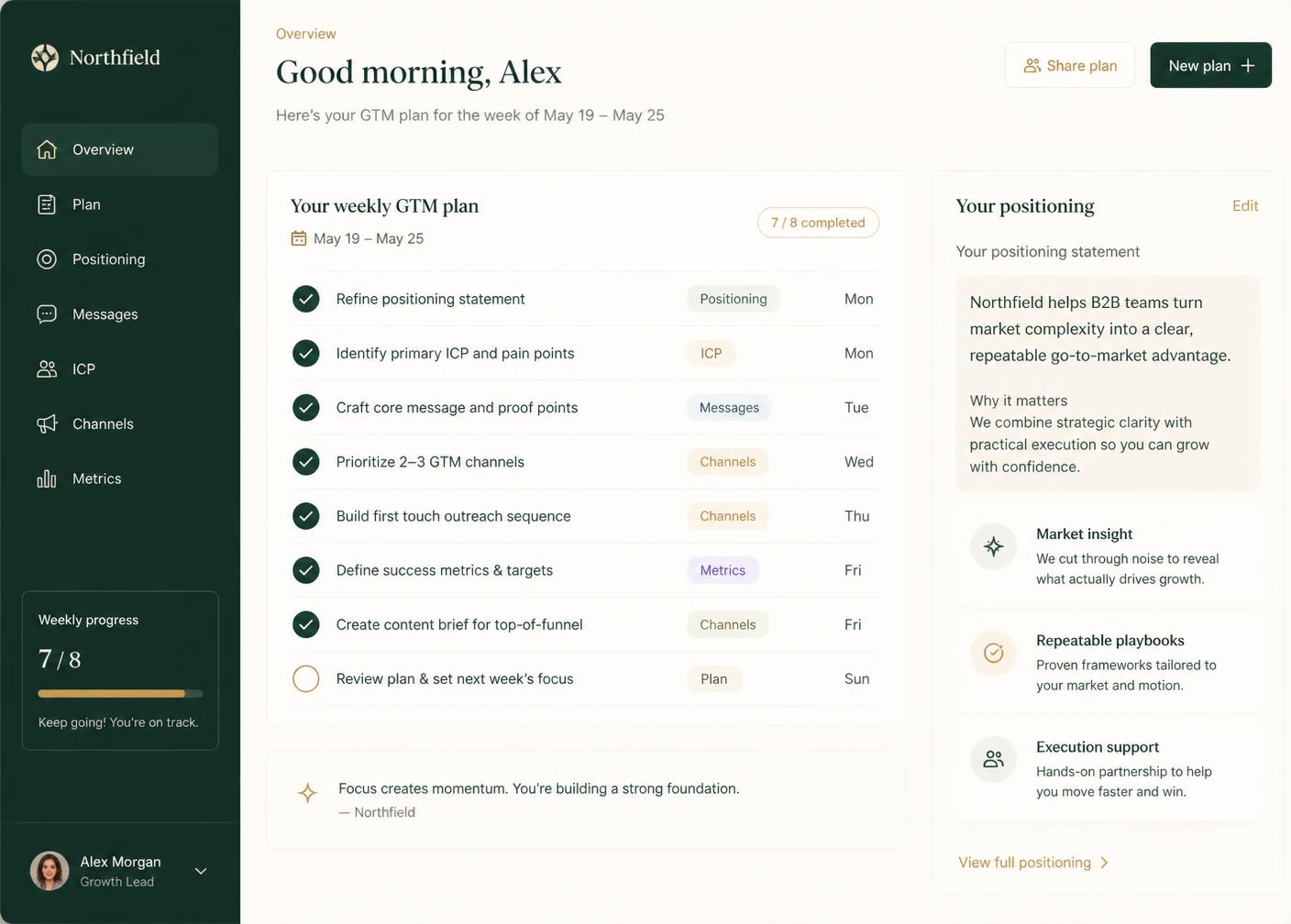
Builderly is an AI-powered platform designed to help founders move from building a product to launching, positioning, distributing, and growing it.
The product is intended for founders using fast-building platforms such as Lovable, Replit, AI coding tools, and no-code tools who can create software quickly but often struggle with customer discovery, positioning, launch planning, content, outreach, and early growth.
The Problem
Building software is becoming faster, but finding customers and creating repeatable distribution remains difficult. The bottleneck for a growing group of founders has moved from shipping to demand.
- Who: solo founders, first-time founders, indie makers, AI product builders, Lovable and Replit users, early-stage SaaS founders.
- Struggle: a working product with no positioning, no ICP clarity, and no repeatable channel.
- Why current solutions fall short: generic marketing content and templates do not know the product, its stage, or its customer.
- Why it matters: products die from lack of distribution far more often than lack of features.
The Opportunity
- Gap: no operating layer between building a product and finding repeatable demand.
- Value: an AI operator that holds persistent product and market context and recommends the next highest-value GTM action.
- Assumptions to validate: that founders will supply enough context, that recommendations are trusted enough to act on, and that weekly execution beats one-off strategy documents.
Discovery and Research
Research to date is founder-problem research drawn from communities, conversations, and direct experience launching my own products. Structured interviews are a planned next step — treat the below as hypotheses, not validated findings.
Insight
Speed exposes the real gap
When building takes days, the unsolved part of the job becomes go-to-market.
Insight
Advice is abundant, execution is not
Founders do not need another playbook; they need the next concrete action for their specific product.
Insight
Context is the moat
Generic output is cheap. Output grounded in the founder's product, stage, and customer is not.
Product Strategy
- Vision: become the operating layer between building a product and finding repeatable demand.
- Target user: early-stage founders shipping fast with AI and no-code tools.
- Value proposition: an AI GTM operator that understands the product, customer, stage, and goals, then recommends and executes the next highest-value go-to-market action.
- Positioning: an operator, not a template library or content generator.
- Principles: context over generic output, execution over advice, weekly rhythm over one-time strategy.
- Success criteria: weekly plan completion, actions actually executed, and founders returning without prompting.
Prioritization and MVP
The workflow surface is wide, so the MVP concentrates on the loop that proves the thesis: understand the product, produce a weekly plan, and track what actually got executed.
Must Have
- Founder onboarding that captures product context
- Positioning and ICP discovery
- Weekly GTM plan
- Progress tracking
Should Have
- Competitor research
- Launch planning
- Content planning
- Landing page messaging
Could Have
- Outreach sequences
- Customer interview preparation
- Channel selection
- Growth experiments
Not Yet
- Full outreach execution and sending
- Deep integrations with product-building platforms
- Team collaboration
- Attribution reporting
User Experience
- Primary flow: onboard the product → confirm positioning and ICP → receive a weekly GTM plan → execute and mark progress → next week adapts.
- The home surface is a command center, not a chat box — the plan is the product.
- Each recommended action carries its reasoning so founders can disagree with it intelligently.
- Screenshots shown are directional product visuals for an in-development product.
Launch and Go-to-Market
- Distribution hypothesis: reach founders inside the fast-building ecosystems they already use.
- Messaging: from built to bought — the GTM operator for products built fast.
- Pricing: [placeholder — to be tested]
- Feedback channels: direct founder conversations and design partners during development.
Results
The product is in development. No outcome metrics exist yet.
- Users: [placeholder]
- Signups: [placeholder]
- Engagement: [placeholder]
- Qualitative: [placeholder — design partner feedback pending]
Challenges and Tradeoffs
- Scope discipline: GTM touches everything, so the risk is building a shallow suite instead of a deep loop.
- Trust: AI recommendations must be specific enough to act on and transparent enough to challenge.
- Context capture: asking for enough detail without making onboarding feel like homework.
What I Learned
- Defining the wedge matters more than mapping the full opportunity.
- An AI product's differentiation lives in its context model, not its prompts.
- Founder empathy is only useful when it is converted into a testable product hypothesis.
- Ecosystem positioning can be a distribution strategy in itself.
What I Would Build Next
Strategic risk: without persistent context and outcome feedback, the product degrades into generic advice. Success looks like founders completing weekly plans and attributing early traction to actions the product recommended.
- Founder onboarding that understands the product deeply.
- Weekly GTM command center.
- AI-generated experiments based on product stage.
- Integrations with product-building platforms.
- Outreach and content execution.
- Feedback loops based on results.
- Customer evidence repository.
- Persistent product and market context.
Reflection
This project strengthened my ability to define product architecture for an AI system, translate a broad problem space into a narrow MVP loop, and reason about ecosystem positioning as both strategy and distribution.