Launched and iterating
AllocateOS
Treat your time like an investment portfolio.
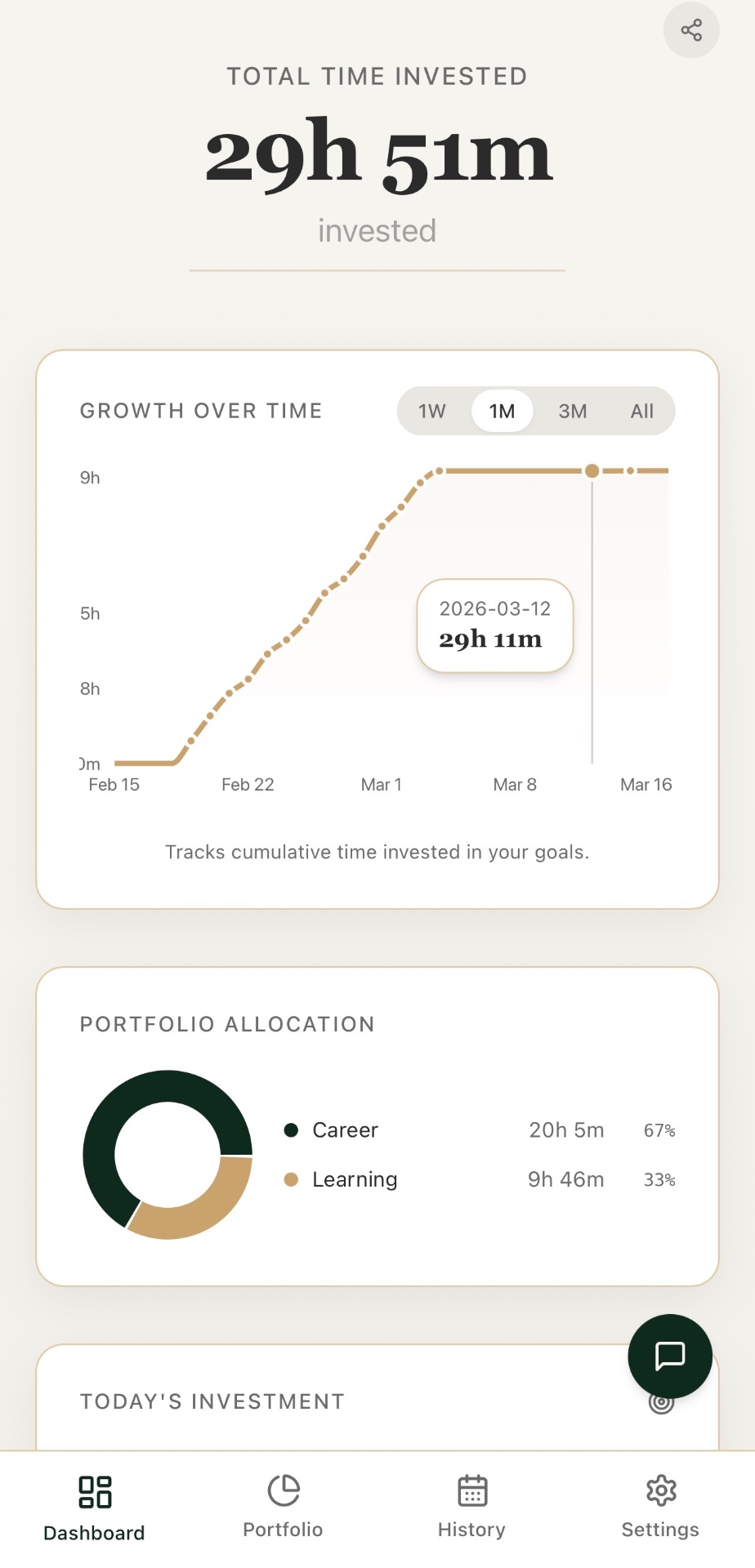
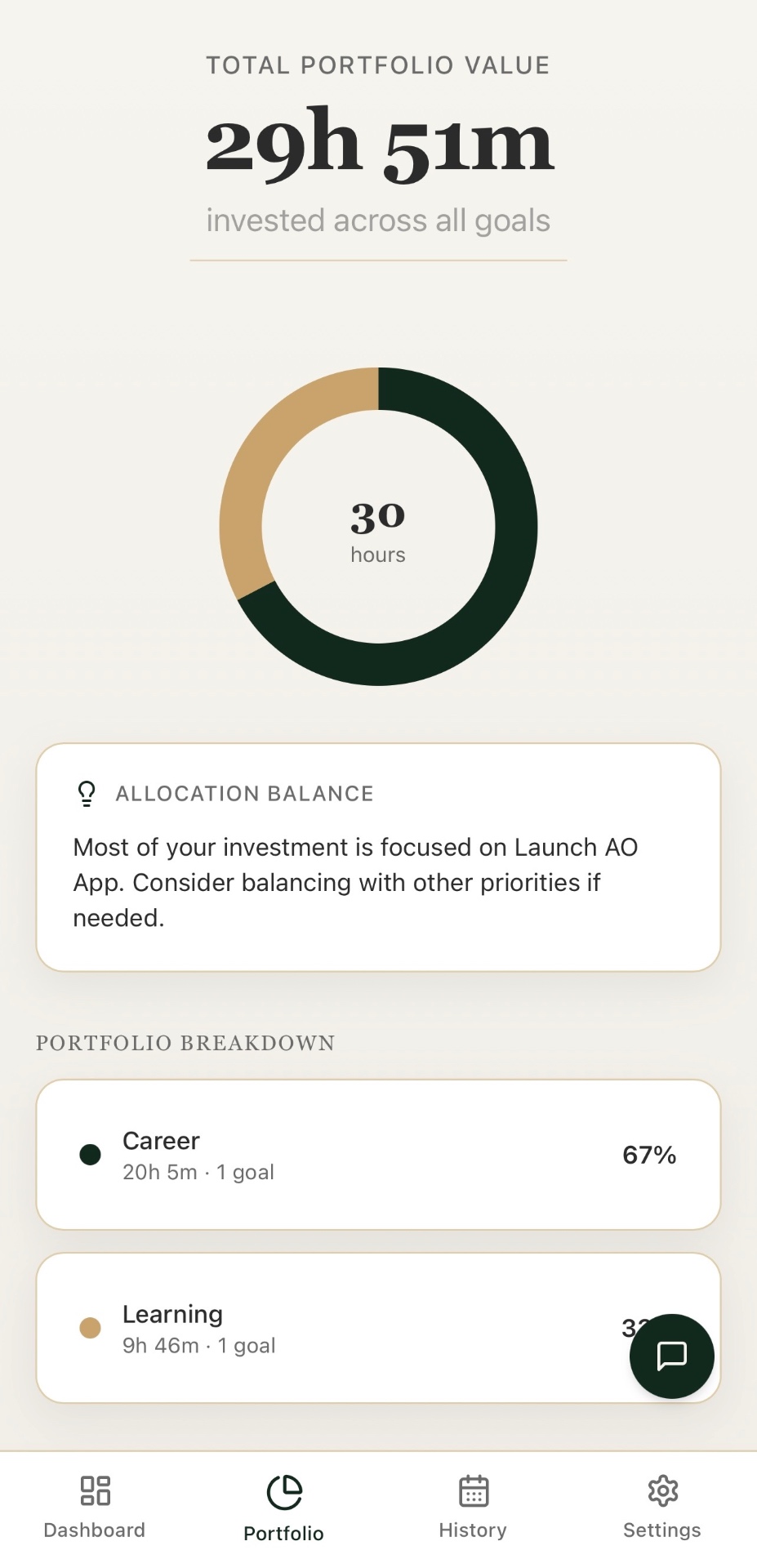
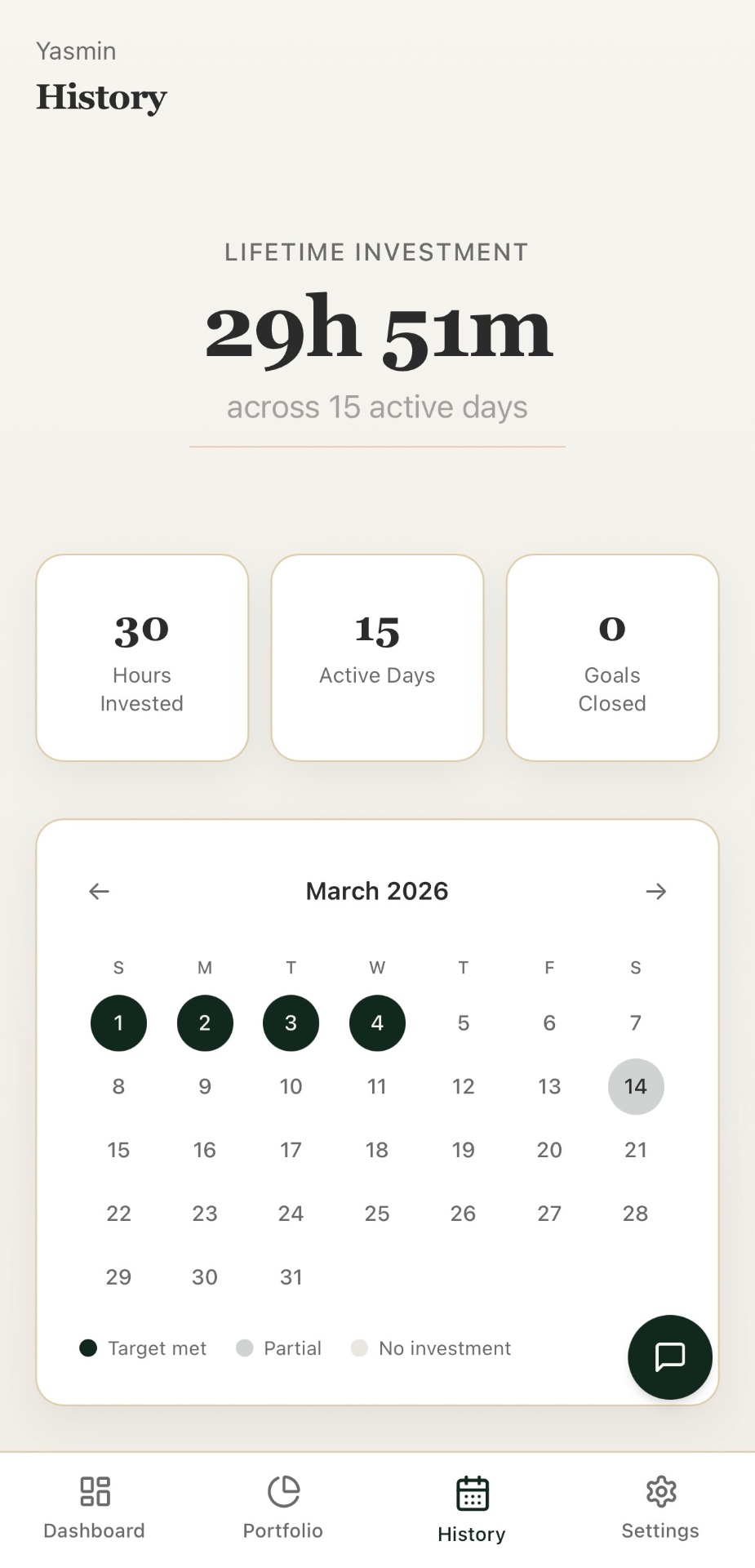
AllocateOS is a productivity platform designed for ambitious people with limited time. It helps users define where their time should go, track focused sessions, maintain a daily investment goal, and understand whether their time allocation reflects their priorities.
The product was inspired by the idea that people carefully monitor money but often have little visibility into where their time is being invested.
The Problem
Ambitious people with limited time rarely lack a task list — they lack visibility. Hours disappear into reactive work while the priorities they say matter most receive whatever is left over.
Existing tools optimise for capturing tasks and closing them. They answer "what should I do next?" but not "is my time actually going where I said it should?" The gap matters because time, unlike money, cannot be recovered once it is misallocated.
- Who: founders, solopreneurs, ambitious mothers, students, and people balancing multiple priorities.
- Struggle: no honest view of where time is invested versus intended.
- Why current solutions fall short: task managers measure completion, not allocation.
- Why it matters: misallocated time compounds quietly, the same way misallocated capital does.
The Opportunity
If time is framed as capital rather than a checklist, the product can ask a different question and earn a different behaviour: a daily investment goal instead of an endless backlog.
- Gap: no calm, premium tool that treats time allocation as a portfolio decision.
- Value: users get an honest allocation picture plus accountability without a traditional task manager.
- Assumptions to validate: that investment language resonates, that people will track actual time rather than plan it, and that a daily goal drives return usage.
Discovery and Research
Research was conducted informally and continuously as a solo founder — conversations, support messages, and observed product behaviour rather than a formal study. Detailed research artifacts are a placeholder.
Insight
Language shapes behaviour
Terms like baseline and threshold created hesitation. Users needed to understand a metric instantly to act on it.
Insight
Real life is messy
People forgot to start timers and wanted to correct history honestly rather than lose the day's record.
Insight
Calm beats gamified
The productivity aesthetic of streaks and confetti felt juvenile to the audience this product targets.
Insight
Distribution is the harder half
Interest in the idea was easier to create than repeatable acquisition.
- Market research: crowded task-management category, few tools framing time as allocation.
- Competitor analysis: timers, trackers, and planners — mostly output-focused.
- Customer feedback: collected through direct conversations and post-launch messages (placeholder for structured synthesis).
Product Strategy
- Vision: give people the same clarity about their time that they expect about their money.
- Target user: ambitious people balancing several priorities with limited hours.
- Value proposition: see where your time is actually invested and whether it matches what you said mattered.
- Positioning: an investment operating system for time, not another to-do list.
- Principles: calm over gamified, honest over flattering, one clear daily goal over many metrics.
- Success criteria: repeat sessions, daily goal completion, and users editing history to keep the record accurate.
Prioritization and MVP
The MVP deliberately measured time actually invested rather than time planned. Planning features were the loudest requests, but they would have re-created a task manager and diluted the mental model.
Must Have
- Focus timer and time investment sessions
- Goals and Daily Investment Goal
- Allocation graph
- Session history
Should Have
- Editable time entries
- Weekly and monthly views
- Consistency score
- PWA installation
Could Have
- AI-generated insights
- Affiliate attribution
- Admin analytics
Not Yet
- Full task planning
- Team and collaboration features
- Deep calendar integration
- Automated goal recommendations
User Experience
- Primary flow: set allocation intent → start an investment session → review the allocation graph → adjust the daily goal.
- Onboarding kept to a single first session rather than a multi-step setup wizard.
- Manual session editing added after observing that users needed flexibility to keep records honest.
- A clearer history experience and date-aware session creation replaced the original append-only log.
- Renamed baseline and threshold to Daily Investment Goal so the metric explains itself.
- Visual language: calm, premium surfaces instead of gamified productivity aesthetics.
Launch and Go-to-Market
- Soft launched through social media and creator partnerships.
- Tested UGC creators as an acquisition channel.
- Added affiliate tracking to attribute referred signups.
- Experimented with pricing, trials, monthly plans, and annual plans.
- Refined messaging around time as an investment across landing page and onboarding.
Results
Quantitative outcomes are intentionally left as placeholders rather than estimated.
- Users: [placeholder]
- Signups: [placeholder]
- Conversion: [placeholder]
- Engagement: [placeholder]
- Qualitative: users responded most strongly to the investment framing and to being able to correct their own history.
- Business learning: distribution required as much design attention as the product itself.
Challenges and Tradeoffs
- Clever terminology slowed comprehension and had to be replaced with plain language.
- Resisting task-planning requests kept the positioning sharp but cost some early enthusiasm.
- Solo constraints meant sequencing product depth against distribution work.
- Pricing experiments ran without enough volume to be conclusive — an open question rather than a finding.
What I Learned
- A differentiated mental model can make a crowded product category feel new.
- Clear terminology matters more than clever terminology.
- Users need flexibility when tracking real behavior.
- Launching a product requires as much attention to distribution as building it.
- Founder intuition should be tested against actual user behavior.
What I Would Build Next
Strategic risk: adding AI depth before the core allocation habit is proven would create surface area without retention. The next validation step is whether a weekly review measurably increases return usage.
- Stronger AI planning and reflection.
- Deeper allocation analytics across weeks and quarters.
- Better onboarding around the first investment session.
- Goal recommendations based on observed allocation.
- Personalized weekly reviews.
- Integration with planning tools.
- Seamless connection to an execution planning product.
Reflection
This project strengthened my ability to define a differentiated product position, translate a mental model into concrete UX decisions, prioritise ruthlessly against louder feature requests, and own outcomes from research through pricing and distribution.